
Wholesale Office Desks: How to Compare Suppliers, Quality and Customization

Buying office desks in bulk takes more than choosing a model and negotiating a lower price. For office furniture dealers, commercial fit-out contractors, distributors and corporate procurement teams, the real challenge is finding a supplier that can meet the required specifications, maintain consistent quality across the order and deliver on schedule.
Two suppliers may offer desks that look almost identical in a catalogue. However, differences often emerge when you compare materials, hardware, construction, customization options and quotation terms. Delivery arrangements and after-sales support matter just as much, especially when an order includes several desk configurations or needs to serve a large office.
This guide explains how to compare wholesale office desks and suppliers before committing to a bulk order. It covers product selection, manufacturing capability, quality checks, customization, total cost and delivery planning, helping you make a more informed purchasing decision.
1. Define Your Requirements Before Buying Wholesale Office Desks
Before contacting suppliers, clarify what the desks need to do, where you plan to install them and how many units the project requires. A clear specification makes quotations easier to compare and reduces the risk of changes after production starts.
Match Desk Types to the Project
Different office desks serve different purposes, so choose models according to the people who will use them and the way the workspace operates.
- Executive desks: Suit private offices and management spaces, often with larger work surfaces and integrated storage.
- Staff desks: Support everyday computer work, paperwork and routine office tasks.
- Modular workstations: Help organize open-plan offices with consistent desk layouts.
- L-shaped desks: Add working and storage space when the room layout allows.
- Height-adjustable desks: Give employees the option to alternate between sitting and standing.
- Meeting and project tables: Support collaboration and help create a coordinated office fit-out.
When you compare wholesale office desks, look beyond the number of models in a supplier’s catalogue. Instead, check whether the supplier can provide compatible desk configurations, storage units and finishes across the range your project needs.
For example, a multi-department office may need executive desks, staff workstations and matching storage. Sourcing these items from a coordinated product range can simplify planning and create a more consistent look than selecting every item separately.
Confirm Dimensions, Quantities and Site Conditions
Measure the available floor area before choosing desk sizes. Account for circulation routes, chair movement, drawers, cabinet doors and shared walkways.
Next, consider the equipment each desk needs to accommodate. A workstation with two monitors, a docking station and paperwork requires more space than one used mainly for a laptop.
For a bulk order, record the following details:
- Desk width, depth and height.
- Quantity for each model and configuration.
- Storage, cable management and accessory requirements.
- Available finishes and project-specific color references.
- Site access, delivery restrictions and installation requirements.
If the desks will go into an existing office, check whether lifts, corridors, doorways and loading areas can accommodate the packaged components.
A detailed product schedule becomes especially useful when your order includes several desk sizes or finishes. It gives the supplier a clear reference for pricing, production and packing.
Separate Standard Products from Custom Requirements
Not every project needs a fully customized desk. Often, a standard model with a different finish or storage configuration will meet the brief.
Before requesting a quotation, divide your requirements into three groups:
- Standard specifications: Existing models, sizes and finishes.
- Configuration changes: Adjustments such as alternative storage units, accessories or selected dimensions, depending on the supplier’s capabilities.
- Custom development: Changes that may require new drawings, engineering review, tooling or prototype approval.
This distinction helps suppliers identify which requests fit their existing production processes and which may affect cost or lead time.
It also prevents a common misunderstanding: a supplier may offer a large catalogue without being able to modify every product easily or economically.
2. How to Compare Wholesale Office Desk Suppliers
A supplier’s website and catalogue can help you build a shortlist, but they only provide a starting point. Next, assess how each company would manage your specific order.
Manufacturer, Wholesaler or Trading Company?
No single sourcing model suits every buyer. What matters most is whether the supplier’s role matches your project’s needs.
A manufacturer may give you more direct access to production details, technical discussions and customization decisions. By contrast, a wholesaler or trading company may offer a wider product selection and coordinate orders across several factories. Either option can work well as long as everyone understands their responsibilities.
| Evaluation point | What to establish |
| Product sourcing | Which products does the supplier make in-house, and which does it source externally? |
| Customization | Who reviews drawings and confirms technical feasibility? |
| Quality control | Who inspects the products, and at which stages? |
| Order management | Who provides production updates and resolves discrepancies? |
| After-sales support | Who handles warranty claims, replacement parts and damaged goods? |
For projects with custom dimensions, coordinated finishes or several related desk configurations, direct access to manufacturing and technical teams can be particularly helpful.
However, do not assume that a company operates its own factory simply because its website calls it a manufacturer. Ask for relevant factory information, production photographs, product specifications and a clear explanation of how the company manages orders.
Verify Manufacturing Capacity and Product Range
A supplier must do more than produce one acceptable sample. It also needs to reproduce the agreed specifications across the required quantity and schedule.
Ask about the production processes relevant to your order. For panel-based office desks, these may include panel processing, edge banding, CNC drilling, assembly and surface finishing. Metal components, painted finishes and electrically adjustable frames may require additional processes.
You should also check whether the supplier has handled orders similar to yours. A project for 200 identical desks has different coordination needs from one involving several models, multiple finishes and phased deliveries.
Useful questions include:
- Which production processes does the supplier handle in-house?
- What production schedule should you expect for the selected products?
- How does the supplier confirm material availability and production capacity?
- Can it manage several desk configurations within one order?
- How will it communicate changes after production scheduling begins?
The goal is not to collect impressive production figures. Instead, determine whether the supplier can manage your order reliably.
Check Quality Documentation and Project References
Request documentation that relates to the products in your quotation. Depending on the project and destination market, this may include material specifications, test reports, relevant product certifications and inspection records.
Check the scope of each certification rather than assuming it applies to every product the company sells. If your client, building project or local regulations require a specific standard, state that requirement before you finalize the order.
Project references can offer further insight. Whenever possible, review examples that involve similar products, quantities or customization needs. A supplier’s experience with executive furniture, for instance, does not automatically prove that it can manage a large modular workstation project.
If you can visit the factory, use the opportunity to review its production flow and quality checks. Otherwise, request current photographs, a video walkthrough or a remote review of the relevant processes.
Evaluate Communication and Order Management
Communication may seem like a minor factor during supplier selection, but it becomes essential when teams need to coordinate drawings, samples, production schedules and shipping arrangements.
A useful quotation should specify the product model, dimensions, materials, finish, included accessories, quantity and commercial terms. The supplier should also identify any exclusions clearly.
Pay attention to how the team handles technical questions. A reliable supplier will clarify uncertain specifications instead of leaving important details unresolved until production.
For complex orders, agree on one approved set of documents. Make sure the quotation, drawings, finish references and sample records all describe the same product configuration.
3. How to Evaluate Office Desk Quality Before Ordering in Bulk
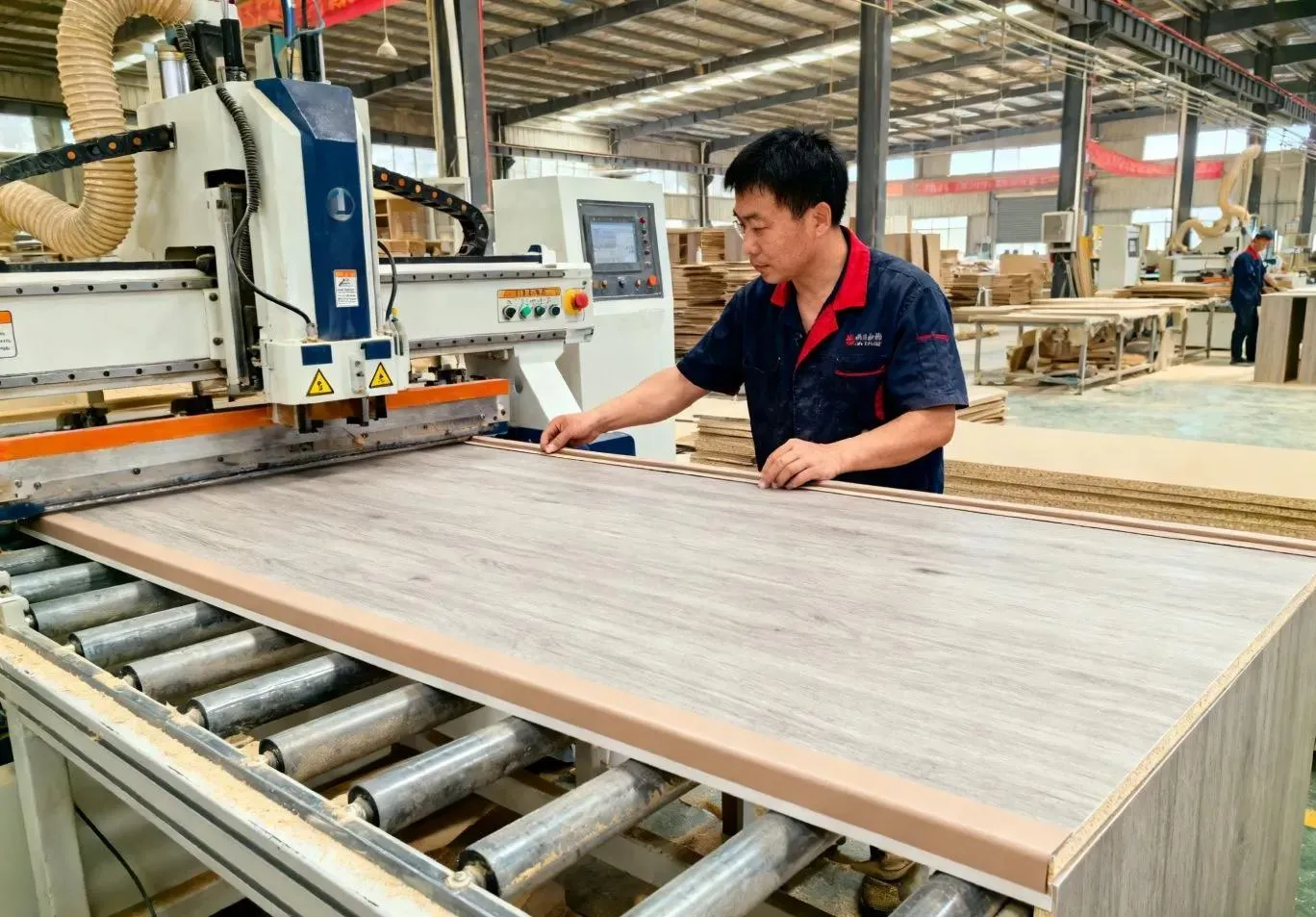
You can assess product quality more effectively when you break it down into visible details. Rather than simply asking whether a desk is “high quality,” define the materials, construction features and performance requirements that matter to your project.
Compare Desktop Materials and Surface Finishes
The desktop influences appearance, maintenance, durability and price. Depending on the product and intended use, common options include decorative laminated panels, high-pressure laminate surfaces and wood veneer.
Each material has different characteristics. Decorative panels can offer a practical balance of appearance, maintenance and cost for general office use. A more wear-resistant laminate may suit areas with heavier daily use, while veneer may work well in executive spaces where a natural wood appearance matters.
Choose according to your budget, design brief, expected use and maintenance needs.
When reviewing a quotation, confirm:
- The specified core material and surface finish.
- Desktop thickness and edge treatment.
- Finish reference or color code.
- Cleaning and maintenance requirements.
- Applicable test reports or performance specifications.
Do not compare desks by surface appearance alone. Two products with similar wood-grain finishes may use different core materials, edge construction, hardware and overall build quality.
Pay particular attention to edge banding on panel-based desks. Poorly finished edges can affect appearance and long-term performance. On a sample, inspect the bonding, alignment, corners and consistency of the edge finish.
Inspect Frames, Joints and Hardware
A desk’s structure affects how well it performs during everyday use.
For desks with metal frames, examine the finish, connection points, leveling feet and attachment between the frame and desktop. For panel-based structures, check the joints, fasteners, connector positions and assembly instructions.
Specify the hardware instead of treating it as an interchangeable detail. Drawer slides, hinges, locks and cable-management components all affect usability and may influence the final price.
For a representative sample, check whether:
- The assembled desk stands level without noticeable wobbling.
- Drawers open and close smoothly.
- Doors align correctly and work as intended.
- Connections fit without forcing parts together.
- Cable openings and accessories sit in the specified positions.
- The supplied instructions and fittings allow straightforward assembly.
If your project includes height-adjustable desks, evaluate the lifting mechanism separately. Confirm the specified height range, rated load, control functions and any relevant noise or stability requirements. Ask for product documentation to support these specifications rather than judging them by appearance.
Review Workmanship and Batch Consistency
One attractive sample does not guarantee that every desk in a large order will look and function the same.
For wholesale office desks, consistency matters across desktop dimensions, finish color, edge treatment, drilling positions, hardware and assembly. Even a small discrepancy repeated across dozens of desks can cause installation problems or make a coordinated office look uneven.
Before production begins, agree on the main inspection points. For example, your project may require dimensional checks on key components, verification of drilled positions, surface-defect inspections and a representative assembly check.
If you order several finishes, confirm which sample or reference represents each one. Avoid relying on informal descriptions such as “light oak” or “warm grey” when the project requires a specific color match.
Inspection criteria should reflect the product’s actual risks. A visible surface defect, a misplaced connector hole and a missing accessory are different problems, so define suitable acceptance rules for each.
Approve Samples and Define Inspection Criteria
Sample approval establishes the version that the supplier must reproduce during production.
Before you approve a sample, check the dimensions, materials, finish, hardware, accessories and assembly details. If the sample differs from the original specification, document the accepted change instead of leaving it informal.
Your approval record should identify the product model, drawing revision and finish reference. Keep photographs or signed records where appropriate, especially when the order includes several models or finishes.
For larger orders, agree on the inspection process in advance. Define who will perform the checks, when they will take place, how the team will record defects and how the supplier will handle products that fail to meet the agreed requirements.
This approach works better than simply asking for “strict quality control.” It gives both parties a shared basis for evaluating the finished order.
4. What Customization Options Should Wholesale Office Desk Suppliers Offer?

Customization often gives buyers a reason to work directly with an office furniture manufacturer. However, treat it as a defined technical process rather than an open-ended promise.
Custom Sizes, Shapes and Desk Configurations
Custom dimensions may help desks fit existing rooms, align with architectural drawings or accommodate a specific workstation layout.
Common requests include revised desktop dimensions, L-shaped configurations, alternative storage arrangements and coordinated desk sizes across departments.
Before requesting a change, check whether it affects more than the desktop. A wider surface may need different support, while a relocated cabinet may affect legroom, cable routing or assembly.
Provide dimensioned drawings wherever possible. Include overall dimensions, critical clearances, accessory positions and site constraints that could affect installation.
The supplier should review the proposed changes and explain any technical or commercial implications before you release the order.
Materials, Colors and Finish Matching
Finish selection may be simple for a single desk but more demanding across an entire office.
Buyers often need a consistent palette across executive desks, staff workstations, storage cabinets and meeting tables. To achieve that consistency, make sure everyone can identify the approved materials and finishes throughout production.
Ask the supplier to confirm the available finishes, relevant material references and whether your preferred color is standard or requires special sourcing.
If the project combines several materials, review them together rather than judging each sample in isolation. A wood-grain desktop, painted frame and storage cabinet may look different under showroom lighting and the actual lighting conditions in the office.
For close color matching, retain approved physical samples and agree on how to assess variations. A digital image alone cannot guarantee an accurate color match.
Read more about [matching finishes across custom office furniture](/custom-office-furniture-finishes/).
Storage, Cable Management and Functional Accessories
Customization should improve how the workstation functions, not just how it looks.
Depending on the desk design, you may need drawer units, mobile pedestals, lockable storage, cable ports, under-desk trays or integrated screen supports. Some projects also need coordinated storage for shared workstations or equipment.
List these requirements in your specification and identify which accessories the quoted price includes. Check that the proposed configuration leaves enough room for chairs, leg movement, electrical connections and maintenance access.
Plan cable management early. Retrofitting cable openings or trays after production can prove difficult and may affect the finished product.
For larger projects, ask the supplier to confirm that the accessories and storage units fit each desk configuration. A coordinated product schedule reduces the risk of ordering components that do not work together.
From Drawings to Approved Samples
A clear approval process helps prevent misunderstandings on custom office desk orders.
A practical workflow usually follows these steps:
- Submit the brief. Provide dimensions, quantities, intended use, preferred materials, finish references and site requirements.
- Review technical feasibility. Confirm which specifications the supplier can meet and identify design or structural questions.
- Approve the drawings. Check dimensions, component positions, accessories and assembly details.
- Review a sample when needed. Confirm the actual materials, finish and construction before releasing production.
- Freeze the approved specification. Record the drawing revision, finish reference and agreed changes.
- Confirm production checks. Identify the inspection points that matter for the order.
Not every standard desk order needs a physical prototype. Match the approval process to the project’s complexity and risk. A standard model with an existing finish may need less development than a desk with revised dimensions and a new surface treatment.
For projects developed from client drawings, see how custom office furniture is developed from client drawings.
5. Compare Wholesale Pricing and Total Order Cost
A lower unit price only helps when suppliers quote comparable products and services.
For example, a cheaper desk may use a different material, exclude accessories or come with different packaging and delivery terms. Before deciding, confirm exactly what each quotation includes.
Request Comparable Quotations
Send every shortlisted supplier the same product schedule. Include quantities, dimensions, materials, finish references, accessories, packaging requirements and the delivery destination.
Where possible, ask suppliers to separate the main cost components. This makes it easier to understand price differences and identify changes that could bring the quotations closer together.
| Cost item | What to confirm |
| Unit price | Exact model, specification and quantity covered |
| Customization | Design changes, special finishes or tooling charges |
| Sampling | Prototype costs and any agreed deductions or credits |
| Packaging | Cartons, protective materials, labeling and special packing |
| Freight | Shipping method, destination and quoted delivery terms |
| Import costs | Duties, taxes and clearance charges, where applicable |
| Installation | Whether assembly, on-site labor or installation materials are included |
| After-sales | Spare parts, replacement arrangements and warranty conditions |
Make sure the final quotation clearly identifies exclusions. If it does not include installation, unloading or import duties, account for those costs separately when comparing suppliers.
Understand MOQ, Lead Times and Payment Terms
Minimum order quantity (MOQ) can affect both the unit price and project flexibility. One supplier may accept a mixed order across several models, while another may set a minimum for each configuration or finish.
Ask how the supplier calculates MOQ and whether you can combine different models to meet it. For projects with several desk sizes or finishes, this distinction can significantly affect your order plan.
Lead time also needs a clear definition. Confirm whether the quoted period starts after the deposit, drawing approval, sample approval or another milestone. Then ask how material availability, production scheduling and specification changes could affect the date.
Review payment terms alongside the production schedule. Establish the deposit, balance payment point, required documents and any conditions linked to inspection or shipment.
Rather than relying on one estimated delivery date, make sure you understand the assumptions behind it.
Evaluate Long-Term Value, Not Just Initial Savings
The purchase price is only one part of the cost of furnishing an office.
Consider maintenance needs, replacement-part availability, ease of assembly and the consequences of a product failing during use. For dealers and distributors, consistency across repeat orders may matter as much as the initial price.
For instance, a slightly cheaper desk may prove less attractive if its finish is difficult to match later or compatible hardware becomes unavailable. On the other hand, a more expensive specification may not justify the extra cost if the workspace has modest usage requirements and a lower-cost option meets the agreed performance criteria.
Use the same assumptions when comparing suppliers. A meaningful total-cost comparison reflects your project’s actual needs rather than a general belief that the cheapest or most expensive product will offer the best value.
6. Check Delivery, Warranty and After-Sales Support
A wholesale office desk order is not complete when production ends. The furniture must arrive in the expected condition, match the approved specification and come with a clear process for resolving problems.
Confirm Production and Shipping Milestones
Agree on key milestones before you release the order. These may include drawing approval, material confirmation, sample approval, production, inspection, packing and dispatch.
For phased projects, specify which desk models and quantities belong to each delivery. If one configuration falls behind schedule, clear records will help everyone coordinate the remaining items.
When the installation schedule is fixed, share the required arrival date and work backward to establish production and shipping milestones. Leave enough time for inspection and receiving procedures where necessary.
The supplier should also explain how it will communicate and manage specification changes, material shortages or production delays.
Review Packaging and Damage Prevention
Office desks often include large panels, corners, hardware and separate storage components. Suitable packaging protects these parts during handling and transport.
Ask how the supplier will protect desktops, edges, metal frames, glass components where applicable and smaller fittings. Also confirm that the cartons or packages will clearly identify the model, configuration and destination.
For multi-unit projects, consistent labeling can make receiving and installation much easier. If a shipment contains different finishes or desk sizes, make sure the packing list identifies them clearly.
Before dispatch, confirm the agreed packing requirements and decide how your team should document visible damage or missing components on arrival.
Clarify Warranty, Spare Parts and Claims Procedures
Review warranty terms before placing the order, not after a problem occurs.
Confirm the warranty period, covered components, exclusions and defect-reporting process. Where appropriate, ask whether the supplier can provide replacement hardware or individual components instead of replacing an entire desk.
Also clarify what evidence a claim requires, such as photographs, product labels, order references or inspection records. Agree on how the supplier will respond to shortages, transit damage and manufacturing defects, since each issue may involve different responsibilities.
For distributors and repeat buyers, record product models and finish references so you can identify them accurately when reordering. This proves particularly useful when an office expands or a customer needs matching furniture several months later.
7. A Practical Checklist for Choosing Wholesale Office Desk Suppliers
Once you have shortlisted suppliers, use the same evaluation method for each one instead of relying on sales conversations or catalogue photographs alone.
The scorecard below offers a starting point. Adjust the weighting to reflect your project’s priorities, and ask for evidence to support important claims.
| Evaluation category | Suggested weight | What good evidence looks like |
| Product quality and specifications | 25% | Complete specifications, approved samples and defined inspection criteria |
| Manufacturing and order capability | 20% | Relevant production information, realistic scheduling and clear responsibilities |
| Customization support | 15% | Technical review, documented drawings and controlled sample approval |
| Total cost and commercial terms | 15% | Comparable quotations with clear inclusions and exclusions |
| Delivery and logistics | 15% | Agreed milestones, suitable packaging and a clear shipping arrangement |
| Warranty and after-sales | 10% | Written terms, claim procedures and a defined support contact |
| Total | 100% |
Use this simple scale to rate each category:
- 1 — Weak: Important information is missing, or the supplier cannot support its claims.
- 2 — Limited: The supplier addresses some requirements, but key questions remain open.
- 3 — Acceptable: The supplier meets the stated requirements and provides reasonable supporting evidence.
- 4 — Strong: The supplier meets the requirements and demonstrates a clear, documented process.
- 5 — Excellent: The supplier provides strong evidence, clear accountability and a process suited to the project’s complexity.
Calculate each weighted score by multiplying the category’s weight by its rating divided by five, then add the results. The maximum score is 100 points.
Use the result as a comparison tool, not as an automatic purchasing decision. Even a high-scoring supplier may be unsuitable if it fails a mandatory requirement, such as a required certification, essential dimension or non-negotiable delivery condition.
Before placing the order, make sure you can answer these questions:
- Have you documented the complete desk specification?
- Have you confirmed the key materials, finishes and hardware?
- Do the approved drawings reflect all custom changes?
- Are the quotation, payment terms and delivery responsibilities clear?
- Have you agreed on inspection and defect-handling procedures?
- Have you documented warranty terms and after-sales contacts?
- Can you identify the approved product accurately for future reorders?
If important answers remain unresolved, settle them before paying a deposit or authorizing production.
8. Why Consider FENLERN for Wholesale Office Desk Projects?
When sourcing wholesale office desks, look for a supplier that can coordinate product selection, technical requirements, production and delivery. FENLERN may be relevant to buyers who need to assess office furniture as part of a broader commercial project rather than purchase individual desks in isolation.
According to FENLERN’s company materials, the business has around 20 years of furniture industry experience and combines research and development, design, production and sales. Its published company profile describes a 40,000 m² manufacturing base and a 6,000 m² showroom, alongside a portfolio of commercial office furniture.
A Range of Products for Different Office Settings
FENLERN’s 2026 catalogue includes executive desks, staff workstations, storage solutions and height-adjustable desk options. Buyers can use this range as a starting point when coordinating furniture across different areas of a commercial workplace.
For example, an office fit-out may require executive desks for private offices, staff desks for open-plan areas and compatible storage for both. Reviewing these needs together can help maintain a consistent appearance while serving the different functions of each space.
Even so, choose each product according to the project’s specifications, available dimensions and intended use.
Manufacturing and Customization Support
FENLERN’s company materials describe production facilities that include woodworking machinery, edge-banding systems, CNC drilling centers, panel-processing workshops, paint spray booths and dedicated assembly facilities.
These processes support the manufacture of panel-based office furniture and the coordination of components across a product range. However, assess the suitability of the production setup against your actual desk specifications and order requirements.
FENLERN also describes support for customized products, office-space planning, design and project-related services. If you are working from architectural plans or client drawings, discuss the exact support you need, including dimensions, finishes, storage, accessories and sample approval.
Product Approval and Project Coordination
For a bulk order, product selection is only the first step. You also need to keep specifications consistent as the order moves from quotation to production and delivery.
Start by preparing a product schedule that lists each desk model, quantity, dimensions, finish and required accessories. FENLERN’s team can then review your requirements and clarify which items fit existing product options and which may need customization.
If you are planning a larger office furniture package, discuss the full project scope before requesting a final quotation. This helps identify dependencies, set approval milestones and resolve important details early.
Planning a wholesale office desk order? Visit the [FENLERN office furniture website](https://www.fenlernfurniture.com/) to explore the product range, or contact the team with your project drawings, required quantities, finish preferences and delivery destination. These details provide a more useful starting point for discussing product suitability and pricing than a general request for the lowest unit price.
Frequently Asked Questions
1.How can I find a reliable wholesale office desk supplier?
Compare product quality, customization options, pricing, production capacity, and delivery reliability. FENLERN can support businesses looking for wholesale office desks and customized office furniture solutions.
2.What should I check before placing a bulk office desk order?
Check the materials, dimensions, finishes, samples, minimum order quantity, and delivery schedule before confirming your order.
3.Can I customize wholesale office desks?
Yes. Depending on the supplier, you may be able to customize desk sizes, materials, finishes, colors, and designs. Contact FENLERN to discuss your project requirements.
4.How can I compare wholesale office desk prices?
Compare the full cost, including product prices, customization, packaging, shipping, and other applicable fees—not just the unit price.
5.Does FENLERN provide office furniture for commercial projects?
FENLERN offers office furniture solutions for B2B buyers. Contact our team to discuss your product selection, customization needs, and project requirements.
Discuss Your Wholesale Office Desk Requirements with FENLERN
The best wholesale office desk supplier is not necessarily the one with the lowest quotation or the largest catalogue. Choose a partner that can meet your requirements, explain how it checks quality and provide clear terms for customization, delivery and ongoing support.
Before requesting a quotation, prepare your desk schedule, estimated quantities, preferred materials and finishes, available drawings and required delivery date. If the project includes several desk types or custom configurations, explain those needs at the outset.
With a clear brief, you can compare suppliers on an equal basis and make a better-informed decision—from specification and sample approval to final delivery.
Contact FENLERN to discuss your wholesale office desk project and explore product options that fit your requirements.

