
Wholesale Office Furniture: A Buyer’s Guide to Sourcing in Bulk

Buying wholesale office furniture is not simply a matter of ordering more desks and chairs at a lower price. For distributors, office furniture dealers, corporate procurement teams, and commercial fit-out companies, a bulk order can affect product consistency, project schedules, warehouse planning, and the cost of future replacements.
For example, a supplier may offer an attractive unit price. However, that price means little if the finish varies between batches, important items arrive late, or replacement parts are difficult to obtain. Similarly, an order that looks complete on paper may still overlook installation requirements, packaging costs, or the needs of different work areas.
For this reason, it is better to approach bulk purchasing as a sourcing process rather than a one-time transaction. By defining your requirements, evaluating suppliers against consistent criteria, and calculating the full cost of ownership, you can make a more informed decision and build a supply arrangement that works beyond the first order.
With these factors in mind, this guide explains how to source wholesale office furniture, compare suppliers, manage bulk purchasing costs, and prepare for a smoother delivery and replenishment process.
1. Define Your Bulk Office Furniture Requirements Before Requesting Quotes

Before contacting wholesale office furniture suppliers, establish what the order needs to achieve. A clear brief helps suppliers provide comparable quotations. More importantly, it reduces the risk of changing specifications after production has started.
Start with the project or sales requirement
First, consider the purpose of the purchase, as different buyers naturally have different priorities. A furniture distributor may need repeatable product specifications and dependable stock availability. By comparison, a company opening a new office may prioritize a complete furniture package, while a fit-out contractor may need products delivered according to a construction schedule.
To make these requirements clear, begin by documenting:
- Order quantity:Estimate the number of desks, chairs, workstations, meeting tables, storage units, and other items required.
- Furniture categories:Identify which products need to be purchased together and which require separate suppliers or specifications.
- Workspace requirements:Consider the number of employees, room dimensions, circulation space, storage needs, and intended use of each area.
- Budget:Set a target range that includes more than the furniture itself.
- Delivery schedule:Establish the required arrival date, site access restrictions, and any phased installation dates.
- Future demand:Estimate whether the order will be followed by replenishment, additional locations, or a larger product range.
Once these details are documented, suppliers have a practical starting point. As a result, you can compare their proposals more easily and identify missing information before committing to an order.
Match furniture specifications to the intended use
In addition to defining quantities, consider how each product will be used. A desk in a private executive office, for instance, may require different materials, dimensions, and storage features from a workstation designed for a large open-plan office. Similarly, seating for a meeting room does not necessarily need the same adjustments as a chair used throughout a full working day.
Therefore, record the dimensions, materials, finish, functional requirements, and expected usage for each product category. If several products will be installed in the same space, also check that their finishes, proportions, and design details work together.
For multi-site projects or dealer inventory, consistent product codes and documented specifications are particularly important. By maintaining these records, you can reduce the risk of different versions of what appears to be the same product entering the supply chain.
2. Where to Buy Office Furniture in Bulk
Once you have defined your requirements, the next step is to identify the most suitable sourcing channel. There is no single option that works for every order. Instead, the right choice depends on quantity, customization requirements, delivery deadlines, local service needs, and the level of control you want over product specifications.
Buying directly from a manufacturer
Working directly with an office furniture manufacturer can be useful when an order involves multiple product categories, custom specifications, private-label requirements, or repeat purchasing.
In many cases, direct sourcing allows buyers to communicate more closely with the production team about materials and manufacturing details. It may also provide greater visibility into production processes and make it easier to coordinate customized products within one project.
However, buying directly from a factory does not automatically guarantee a better outcome. You still need to check quality control, minimum order quantities, production capacity, export experience, and the supplier’s ability to manage your specific order.
Buying through a wholesale distributor
Alternatively, wholesale distributors can be a practical choice when buyers need established product ranges, stocked items, consolidated purchasing, or access to local delivery and service arrangements.
Their suitability, however, depends on the range they carry and whether they can maintain availability across repeat orders. For specialized commercial projects, confirm whether the distributor can provide the required dimensions, finishes, and supporting documentation before proceeding.
Working with a local dealer or fit-out partner
Local dealers and fit-out companies offer another option, particularly when a project requires site measurement, installation, delivery coordination, or responsive after-sales service. These services can be especially valuable when site schedules are tight or installation requirements are complex.
On the other hand, the available product range, customization options, and pricing structure may differ from those offered by manufacturers. Therefore, it is worth comparing the full service package rather than looking at product prices alone.
Compare sourcing options against the same criteria
To make a fair comparison, evaluate each sourcing channel using the same criteria instead of assuming that one option is always cheaper.
|
Evaluation factor |
What to verify |
|
Product range |
Can the supplier cover the required furniture categories? |
|
Customization |
Can dimensions, finishes, materials, or configurations be adjusted? |
|
Order quantity |
Are the minimum order quantities suitable for the project? |
|
Quality control |
Can specifications and inspection procedures be documented? |
|
Delivery |
Who coordinates freight, receiving, and installation? |
|
Repeat orders |
Can the same models and finishes be supplied later? |
|
Service |
Who handles defects, missing parts, and warranty claims? |
Ultimately, the best sourcing option is the one that fits the project’s requirements and manages its risks. In other words, the lowest quoted price is not necessarily the most economical choice over the full purchasing cycle.
3. How to Evaluate Wholesale Office Furniture Suppliers
After narrowing down your sourcing options, evaluate individual suppliers more closely. A catalog can show what a company offers; however, it cannot prove that the company can deliver a large order consistently.
For that reason, assess the supplier’s product range, manufacturing or supply capability, customization process, communication, and ability to provide support after delivery.
Look for a product range that fits the project
For a complete commercial office, the furniture requirement may extend beyond desks and chairs. Depending on the project, you may also need workstations, conference tables, executive furniture, reception counters, storage cabinets, and lounge seating.
When one capable supplier can cover several categories, purchasing and coordination may become easier. In addition, using a coordinated product range can help maintain a consistent appearance throughout the space.
Nevertheless, a broad catalog should not be the only deciding factor. Confirm that the supplier can deliver the required specifications and quantities before treating its full product range as an advantage.
Verify production and supply capacity
For large or time-sensitive orders, it is equally important to understand how the supplier manages production planning, component availability, quality checks, and order scheduling.
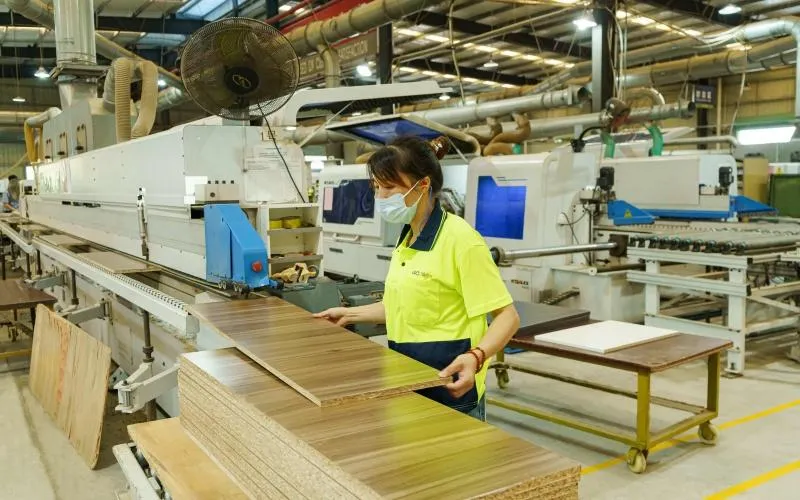
If the supplier operates its own manufacturing facilities, a factory visit, live video inspection, or documented production review can provide useful evidence. During this process, ask which manufacturing stages are handled in-house and which depend on external partners.
For stocked products, verify actual availability rather than relying on general statements about inventory. Meanwhile, for made-to-order products, request a schedule that identifies the main approval and production milestones. This makes it easier to assess whether the proposed timeline is realistic.
Assess customization and project support
Another important consideration is whether the supplier can accommodate your product and project requirements. Commercial buyers may need adjustments to desk dimensions, surface finishes, storage configurations, fabrics, colors, or product combinations. Similarly, private-label buyers may require product identification, packaging, and branding arrangements.
Before proceeding, establish exactly what can be changed, what requires new tooling or development, whether samples are necessary, and how changes may affect price and lead time.
Beyond customization itself, project support can also influence the purchasing decision. Depending on the supplier, useful services may include space planning, design visualization, technical drawings, finish selection, installation guidance, and coordination between different furniture categories.
Evaluate communication before placing the order
The quotation stage also provides an early indication of how the supplier manages details. For example, does the sales team ask questions about dimensions and quantities? Are specifications documented clearly? Are exclusions and additional charges explained? Can the supplier identify who will handle production updates and after-sales issues?
Although a quick response is useful, speed alone is not enough. A supplier that responds quickly but gives vague answers may create problems later. Instead, look for clear commitments, written records, and a defined contact for each stage of the order.
4. Check Product Quality Before Committing to a Bulk Order
Once you have identified a potential supplier, the next step is to verify product quality. This is particularly important for bulk orders because quality problems become more expensive when they affect dozens or hundreds of units.
For instance, a minor variation in finish or a recurring hardware issue may be difficult to notice in a single sample but obvious across an entire office. Consequently, product approval should cover both the individual item and the consistency of the production batch.
Review materials, construction, and hardware
For desks, workstations, and storage furniture, examine the specified board or panel material, surface finish, edge treatment, frame construction, joints, and hardware. In addition, check that drawers, hinges, locks, and sliding mechanisms operate as intended.
For upholstered furniture, review the fabric or covering, seams, cushioning, frame, and supporting components. When assessing office chairs, pay particular attention to the base, casters, adjustment mechanisms, stability, and suitability for the intended use.
Rather than relying on broad descriptions such as “premium material” or “commercial quality,” request actual material specifications. Where relevant, also ask for supporting test reports or certifications.
If a project requires compliance with a particular market standard, specify that requirement in the purchasing documents and verify the applicable evidence. A supplier’s international sales experience, on its own, does not prove that every product meets the standard you need.
Approve samples and finish references
Samples provide a practical way to assess color, texture, workmanship, and functional details before approving a larger order.
For significant projects, establish a clear sample-approval process. Record the approved finish, material, dimensions, hardware, and product revision. Where practical, keep physical samples or reliable reference photographs for later comparison.
However, sample approval should not be treated as a substitute for production inspection. To maintain consistency, the supplier should also explain how it checks that finished goods match the approved specifications.
Establish a documented inspection process
Before production begins, agree on the inspection criteria and how defects will be handled. This step helps both parties understand what constitutes an acceptable product and how discrepancies should be resolved.
Depending on the order, checks may include:
- Dimensions and configuration against the approved drawings.
- Surface finish, color consistency, and visible workmanship.
- Stability, assembly fit, and hardware operation.
- Product quantity, model identification, and accessory completeness.
- Packaging condition and protection for transport.
- Compliance with any agreed testing or certification requirements.
For larger orders, consider a pre-shipment inspection based on the project’s risk and value. By recording the findings and resolving significant discrepancies before shipment, you can reduce the likelihood of costly problems after delivery.
5. Compare Prices, Minimum Order Quantities, and Total Costs
After reviewing product quality and supplier capability, compare the commercial terms. Bulk purchasing can reduce the unit price, but a lower unit price does not always translate into a lower overall cost.
For a meaningful comparison, make sure each quotation specifies the same products, materials, finishes, quantities, delivery responsibilities, and service scope.
Compare like-for-like quotations
When requesting quotations, provide each supplier with the same product schedule and technical requirements. Then ask for itemized pricing instead of a single total.
In particular, check whether the quotation includes:
- Product specifications and quantities.
- Customization, tooling, or sample charges.
- Packaging and protective materials.
- Inland transport, international freight, and insurance where applicable.
- Import duties, taxes, and customs-related costs where applicable.
- Delivery to the agreed destination.
- Installation or assembly, if required.
- Spare parts, warranty coverage, and after-sales support.
Not every supplier will include every item. Therefore, make sure all exclusions and additional charges are visible before comparing the final prices. Otherwise, an apparently cheaper quotation may turn out to be more expensive once the missing costs are added.
Understand minimum order quantities
Minimum order quantity (MOQ) can affect both the purchase price and the amount of capital tied up in inventory.
A larger order may qualify for better pricing. At the same time, it can increase storage requirements, slow-moving stock, and the risk of holding products that no longer match customer demand.
For this reason, ask whether the MOQ applies to the total order, each model, each finish, or each customized configuration. A supplier may accept a large combined order while still requiring a separate minimum for individual products or finishes.
For distributors, it may be worth comparing a larger initial order with a smaller trial order followed by replenishment. The better option depends on sales forecasts, stock availability, cash flow, and the cost of placing subsequent orders.
Calculate the total landed cost
For international buyers, landed cost provides a more realistic comparison than the factory price alone.
A useful calculation is:
Total landed cost = product cost + packaging + transport + insurance + applicable duties and taxes + destination handling + other order-specific charges.
After calculating landed cost, you can also add installation, maintenance, and expected replacement costs when evaluating the broader cost of ownership.
For example, a lower-priced product may become less attractive if it requires more complicated assembly, incurs higher shipping costs, or is difficult to replenish. Conversely, a more expensive option may offer better value if it lasts longer or reduces maintenance and replacement needs.
Ultimately, the goal is not to select the most expensive product. Rather, it is to understand what you are paying for and identify which costs may emerge after the purchase.
6. Plan Production, Shipping, and Delivery Before You Place the Order
Once the supplier and commercial terms have been agreed, turn your attention to production and delivery planning. This stage should begin before production starts, especially when furniture is being purchased for an office opening, renovation, or multi-location rollout.
A delay can affect contractors, installation teams, employee move-in dates, and other work scheduled around the furniture delivery. Therefore, a realistic schedule is just as important as a competitive quotation.
Confirm realistic lead times
Ask the supplier to separate the main stages of the order, including specification approval, sample approval if needed, production, inspection, packing, and dispatch.
For international orders, shipping and customs clearance should be considered separately from factory production time. The final schedule also needs to account for the agreed shipping method, destination, and receiving arrangements.
Rather than relying on a general statement such as “delivery in four weeks,” confirm when the timeline starts, which approvals are required, and what happens if specifications change after production has begun.
Decide whether to ship everything together or in phases
A single consolidated shipment may simplify coordination and reduce repeated handling. However, phased deliveries can be more practical when different floors, buildings, or locations will be ready at different times.
To decide which approach works best, discuss the options with both the supplier and installation team. Each shipment should have a clear product list, destination, delivery window, and responsible contact.
For overseas shipments, also confirm the agreed trade terms, export documentation, packaging requirements, and responsibility for freight, insurance, customs clearance, and destination charges.
Prepare for receiving and installation
Delivery planning does not end when the goods leave the supplier. Before shipment, establish how the furniture will be labeled and packed. For large projects, labels should make it easy to identify product models, quantities, cartons, and intended locations.
At the same time, prepare a receiving area, unloading arrangements, access routes, and a process for recording visible damage or missing items.
If installation is required, confirm who will perform it, whether drawings or assembly instructions will be supplied, and how site changes will be handled. With these details agreed in advance, you can reduce the chance that furniture arrives before the site is ready or that installation teams have to search through unidentified cartons.
7. A Practical Checklist for Buying Wholesale Office Furniture in Bulk
Before approving the purchase order, use the following checklist to review the key decisions. It brings the earlier recommendations together and helps ensure that important details are not overlooked.
Requirements and specifications
- Quantities, product categories, and delivery locations are confirmed.
- Dimensions, materials, finishes, and configurations are documented.
- Budget and delivery deadlines are agreed.
- Future replenishment requirements have been considered.
Supplier evaluation
- Product range and supply capacity match the order.
- Customization requirements and associated costs are confirmed.
- Quality-control procedures and relevant compliance documents are reviewed.
- Production or stock availability has been verified.
- Communication and project responsibilities are clear.
Commercial terms
- Quotations are compared using equivalent specifications.
- MOQ and minimum quantities by model or finish are understood.
- Payment terms, shipping terms, and quotation exclusions are documented.
- Warranty, spare parts, and defect-handling procedures are agreed.
Delivery and acceptance
- Production and shipping milestones are confirmed.
- Packaging, labeling, and delivery arrangements are documented.
- Receiving and installation responsibilities are assigned.
- Inspection criteria and the process for resolving discrepancies are agreed.
By completing these checks before placing the order, you can address potential gaps early. This is generally easier than resolving missing specifications, unexpected charges, or delivery disputes after production or shipment has begun.
8. Build a Long-Term Wholesale Office Furniture Supply Partnership
Although the first order is important, a successful sourcing relationship should also support future purchases. For distributors, dealers, and businesses that expand or refurbish offices regularly, the ability to repeat an order accurately can be just as important as the initial price.
To support this consistency, keep records of approved models, dimensions, finishes, hardware, packaging specifications, and product revisions. Whenever a product is updated, ask the supplier to identify what has changed and whether the new version remains compatible with previous orders.
It is also worth discussing how the supplier handles discontinued products, replacement components, warranty claims, and changes in demand. These details become especially important for dealers managing customer commitments or companies maintaining similar workspaces across several locations.
In addition, support the relationship with clear commercial terms and measurable performance standards. Review delivery reliability, defect rates, responsiveness, and the supplier’s ability to maintain specifications over time.
How FENLERN Supports Commercial Office Furniture Projects
For buyers sourcing wholesale office furniture, a manufacturing partner that connects product selection, customization, production, and project support may help simplify the purchasing process.
FENLERN Furniture, based in Foshan, China, serves commercial procurement and project requirements through its office furniture product range and manufacturing operations. According to company materials, FENLERN has a 40,000 m² manufacturing base, production equipment including CNC drilling centers and edge-banding systems, and services covering office space planning, customization, and installation drawings.
Furthermore, its product offering covers multiple office environments, including executive spaces, staff work areas, and meeting spaces. For buyers managing a commercial project, the next step is to match the required product schedule against the available range and confirm specifications, quantities, lead times, and service scope directly with the company.
Whether you are sourcing furniture for a dealer range, a new office, or a commercial fit-out, sharing your product list, estimated quantities, preferred finishes, and delivery destination gives the supplier a practical basis for discussing product suitability and preparing a quotation.
Planning a bulk office furniture order? Contact FENLERN Furniture to discuss your project requirements, customization options, and supply arrangements.
Frequently Asked Questions
1. Is buying wholesale office furniture cheaper?
Yes, bulk orders can reduce unit costs. However, compare shipping, customization, and other charges before choosing a supplier.
2. Where can I buy office furniture in bulk?
You can buy from manufacturers, wholesalers, or local dealers. FENLERN Furniture provides office furniture solutions for commercial projects and bulk purchasing needs.
3. What should I check before placing a bulk order?
Check product quality, materials, pricing, minimum order quantities, delivery times, and warranty terms. FENLERN Furniture can discuss your project requirements and available options.
4. Can FENLERN Furniture provide customized office furniture?
Yes. FENLERN Furniture supports customization for commercial office projects. Contact the team to confirm specifications and available options.
5. How can I get a quotation from FENLERN Furniture?
Share your product list, estimated quantities, preferred finishes, and delivery destination to help FENLERN Furniture assess your requirements.
Final Thoughts
Buying wholesale office furniture in bulk requires careful planning, reliable suppliers, and clear product specifications. By comparing quality, total costs, customization options, and delivery schedules, you can make better purchasing decisions and reduce potential risks.
FENLERN Furniture supports commercial buyers seeking office furniture solutions for different project needs. Whether you are furnishing a new office, sourcing products for distribution, or planning a commercial fit-out, the right sourcing partner can help simplify the process.
Contact FENLERN Furniture to discuss your bulk office furniture requirements and explore suitable solutions for your business.

